The match rates
In simple terms, “matches” or “hits” are translation units in the translation memory that are identical or similar to the new text to be translated. The system calculates how similar the existing TU is to the new text and expresses this as a percentage, which then falls into a certain category or match rate. Let’s take a closer look at these match rates.
When you commission a new translation, we prepare the documents for the translators and also add the relevant translation memories to the translation project. The system displays the matches between the translation memory and the text to be translated as a percentage and automatically groups these matches into the following categories:
- Context Matches (also CM for short)
- Repetitions
- 100% Matches
- 95-99% Matches
- 85-94% Matches
- 75-85% Matches
- 50-74% Matches
- No Match (new text)
Segments in the text to be translated that match a translation unit in the translation memory exactly are classed as a 100% match. However, the match does not only refer to the text itself; the formatting must also be the same. If the translation memory finds a 100% match in both the previous and subsequent segment, we refer to this as a context match.
All other segments with a similarity value below 100% are called “fuzzy” matches. The translators already receive suggestions for these segments from the translation memory, but they still have to make small changes depending on the degree of similarity. If there is no match from the translation memory, the system classifies the affected segments as new text or “no match”.
Proper segmentation
The most important starting point for working effectively with a translation memory is the correct segmentation or division of the text into complete sentences. Non-editable formats often pose particular challenges, as the system is unable to read the document correctly and sections of text that should belong together in a single unit then are broken down into different segments instead. As a result, the translation memory will show no or only very low hit values for these segments, even though the complete sentence may actually be available in the translation memory.
Let’s take a closer look at the following example:
“Die Katze ist weiß”
Together with its English equivalent “The cat is white”, the segment is already in the translation memory:
If this sentence now occurs again in one of your translation projects, the translation memory system automatically inserts the translation – provided the segmentation is correct.
This can be clearly explained with the following example:

In segment 3, we receive a 100% match from the translation memory, as the segment is also present in the TM. The translation memory system therefore automatically fills the segment with the English equivalent “The cat is white”.
In segments 1 and 2, however, things look a little different. This is because segments 1 and 2 actually form a single sentence, but the system has not read the source file correctly and has split one sentence into two segments. The translation memory system now does not recognize that the sentence already exists and does not display a match due to the lack of similarity.
Proper segmentation therefore plays an important role in ensuring that translators have easy access to the translations in the translation memory, which is why we as the project management team will also draw your attention to passages that are not segmented correctly and correct them before your content is sent for translation.
Top tip: In Word documents, it is easy to check whether sentences are too long or incorrectly separated. Changing your view settings to display the paragraph markers (hard return) and manual line breaks (soft return) makes it possible to quickly find superfluous hard returns and remove them if necessary.
Fuzzy matches in practice
If the segments are more similar to existing content in the TM than in the example above, the translation memory system displays different fuzzy match values:
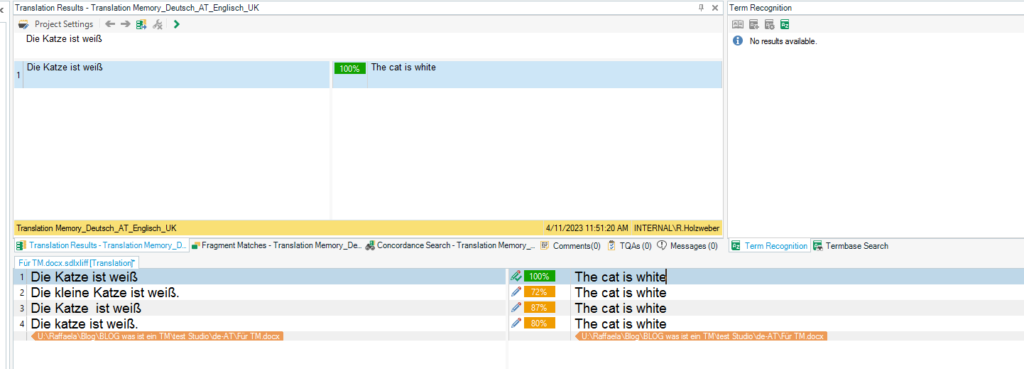
Let’s take a look at the match values together.
In the first segment, the source sentence is exactly as it appears in the translation memory. This segment is therefore displayed as a 100% match. Segment 3 is also very similar, but has a double space between “Katze” and “ist”. This means that it can no longer be a 100% match due to the different formatting, but a fuzzy match, in this case 87%.
In segment 2, both the word “kleine” and the period at the end of the sentence have been added. We therefore also have a fuzzy match here (match value 72%). The same applies to segment 4, in which, in addition to the period, there was also a change in the spelling of “katze” (small “k”). This also results in a fuzzy match (80%) and not a 100% match.
Once the translators have adapted the segments and completed the translation, we import the translation directly into your translation memory. Now the fuzzy matches from the example above will be treated in future as 100% matches, as the next time these segments appear in one of your translations, they will already be in the translation memory.
Concordance search
If the translation memory system does not display any hits in a segment, translators can also actively search the translation memory for specific terms using the concordance search:
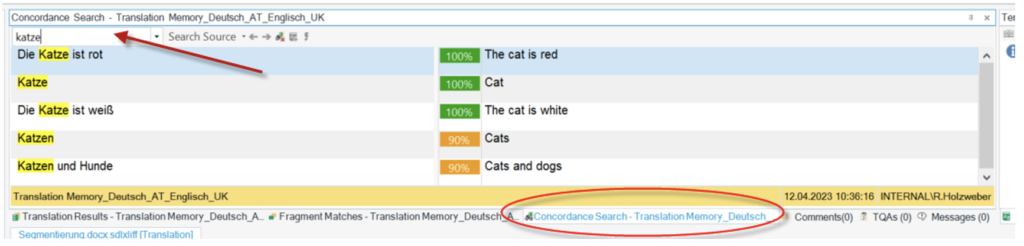
For example, if the translator types in the term “Katze“, the translation memory displays all segments in which this word occurs. The translators can thus access existing translated content and deduce the correct translation.
This function is also useful if you send several files over a longer period of time, as the concordance search allows translators to quickly check and reuse the correct terminology. If the translators cannot find a match using the concordance search, they will create a translation that sounds most idiomatic in the given context.
In addition to the translation memories, translators often also have access to a terminology database in which the most important terms are recorded in several languages. This database may be thought of as a kind of glossary that translators use in addition to the TM and often as the primary reference for terminology.
Three tips for a well-maintained translation memory
Last but not least, we would of course like to share our three most important tips on managing a translation memory with you:
1. Maintaining and growing the translation memory
Keeping the content of your translation memory clean and up to date is crucial if translators are to rely on it. As project managers, we ensure that all new translations are entered into your translation memory and made available to the translators.
When importing the translations, we also ensure that no duplicates are created and that the translation memory system overwrites any identical segments that have been updated or amended. After each translation, the number of new units in the translation memory increases, which also increases the probability of more matches in future translations.
2. Granting access to translators
As the workload of regular translators can vary greatly, it is sometimes necessary to outsource translations to other translation teams with your consent. We give the other teams access to your translation memories so that they can also produce high-quality translations that are consistent with previously translated content. Having access to your TM makes it easier for them to select the right terminology and the translation memory is treated as an important reference source in their translation process. In this way, we can ensure that the translations of the alternative teams also meet your expectations.
3. A translation memory is only as good as its content
The golden rule for translation memories is that a translation memory is only as good as its content. It is important that the target language segments reflect the source text. Sometimes a client may change segments during the review process, adding new information that is not actually present in the original text.
These “incorrect” translations can easily end up in the translation memory, which the system then reproduces as 100% matches the next time the source segment appears. Translators then have to spend time and money changing these segments back to reflect the source text. That’s why we in the project management team always make sure that only clean content is entered into the translation memory.