

What is a terminology database?
Put simply, a termbase works like a dictionary that collects industry- and/or company-specific terminology. Primarily, it’s about collecting, structuring, and managing concepts and the terms used to designate them. Initially, this can happen in just one language, ideally your company’s working language. The goal is to define precisely:
- What concepts exist within the organization?
- How are these concepts referred to in day-to-day work?
- How should these concepts be referred to in your texts?
You might be thinking: that sounds like a lot of effort, is this really necessary?
So let’s play a little thought experiment.
Imagine your company manufactures the following product:

The concept is clear: a basket used for storing and presenting bread and other baked goods. But within your company, the marketing team prefers to call it a ” bread basket,” the documentation team prefers “bread bin,” and internally, for the sake of simplicity, everyone just says “basket,” since all employees know what is meant anyway.
As you can see, three different terms — “bread basket,” “bread bin,” and “basket” — are in circulation for one and the same concept. To be able to produce consistent texts for internal and, above all, external purposes, it’s therefore necessary to reach a consensus. That’s where the termbase comes in. For example, it is specified there that documentation must always use “bread basket” and that the use of “bread bin” is forbidden in this area. This gives all writers clear guidelines and, as a result, consistent and unambiguous texts for all target audiences.
These specifications are important not only for the source language, but also for all translations. That’s why there should be a termbase for all target languages, giving all translators clear guidance on how certain terms are to be translated. This ensures that the consistency of the texts is also guaranteed in the translations. The databases don’t always have to be in place before translation starts; they can also be built up gradually as needed. If you’d like to learn more about where to start with managing your company terminology, feel free to contact us anytime.
What are the benefits of a termbase?
As mentioned, a major benefit of a multilingual termbase is that texts can be written consistently not only in the source language, but also translated consistently into all target languages. It’s important to bear in mind that a termbase can also serve as an important knowledge base, providing translators with information and definitions on the concepts and terms that matter to your company. Although the translators we work with are always specialized in their respective fields, they don’t always have knowledge of your highly specialized vocabulary or your specific concepts and terms. Without the support of a database, they would often have to do extensive research and ask you numerous terminology questions. For translations to be representative of your industry and your company, a termbase is therefore essential.
When a termbase is integrated into a translation project, translators receive a notification via the automatic term recognition feature during translation that a prescribed translation is stored in the database for one or more of the words encountered — and can use it immediately.
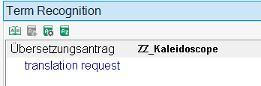
Screenshot from the Quickterm terminology database
The key benefits of a termbase:
- Consistent source texts and translations
- Correct use of company or industry-specific terminology
- Time and cost savings in the long run
- Quality assurance and verifiability through the use of terminology verification software
What is a translation memory?
A translation memory is a translation store in which translated texts are automatically collected and kept for reuse. A separate translation memory is created for each source and target language combination, in which the translations are stored after the usual review and approval by our project management team.
The environment in which translation takes place is called a CAT tool (computer-assisted translation tool). When a text is imported for translation, the CAT tool automatically breaks it down into individual translation units, known as segments. Segmentation is mainly based on punctuation marks, which is why a segment is usually an entire sentence or a similar unit of meaning. After translation, the source segment is stored together with the translated target segment as a single unit in the translation memory.
When you send a new translation request and we have, for example, already translated a previous version of the texts into that language, the CAT tool shows the translators the stored segments. This allows the teams to fall back on their previous translations, so texts that already exist at least partially in the target language don’t have to be retranslated from scratch.
To ensure, however, that the stored translations are also appropriate for the new text, even 100% matches are reviewed again by the translators. After all, the translation suggestion may come from a different type of text, or it may not be correct in the given context despite the matching source text.

Screenshot from the Trados Studio Translation Memory System
What are the benefits of a translation memory?
Using translation memories in translation means translators don’t have to reinvent the wheel every time. If you publish a software update and want the corresponding technical documentation updated, it would be a massive effort to have everything translated from scratch. The costs would be enormous, and depending on the scope, it would take weeks or even months. For every new update! Translation memories make it possible to keep this effort to a minimum and to “recycle” existing translations, as it were. This keeps the different versions as consistent with each other as possible, since only those parts of the text that were actually added or rewritten are changed.
If there is no termbase in-house yet, a translation memory can also serve as a terminology reference. Using the so-called concordance search, translators can search for terms or phrases like in a search engine to find out specifically how they were translated in the past.
At Greatcontent, we manage individual translation memories for all our key accounts, continuously update them with new translations, and include them in new requests right from the start. Depending on the match rate, the stored text segments are billed at a discount to reflect the actual translation effort when translation memories are used. This saves time and money and, in turn, ensures that your texts are translated consistently across many separate projects.
The key benefits of a translation memory:
- Consistent translations through the “recycling” of translation units
- A reference for translators
- Time and cost savings, especially the recurring content
- A repository of all your translations
How does a termbase differ from a translation memory?
Let’s summarize the key similarities and differences between termbases and translation memories once again:
Similarities
- Both are databases that store multilingual texts or text segments for use in future translations
- Separate translation memories and termbases are usually created for each key account, tailored to their specific needs
- Both serve as a reference in the translation process and help to save time and money
- Both are context-dependent, which is why translators must always first check whether the suggestions from both sources are actually suitable for the specific use case
Differences
- In most cases, a termbase contains individual words or short phrases, while a translation memory stores entire sentences and units of meaning
- A termbase can be monolingual or include any number of languages, while a translation memory always covers exactly one source language and one target language. A new translation memory must be created for each additional combination, including, for example, the reverse language pair
- Termbases can be created for a specific purpose (e.g., one database for GUI strings, another for marketing texts), while a translation memory usually covers all types of translation project of the specific language combination for a key account
- A translation memory relies more on quantity: the more translations are stored, the more helpful it is in new projects. With a termbase, even a few entries for a company’s key terminology can provide significant added value from the very first project on
As with all databases, it’s worth noting here that the output can only be as good as the input. Colloquially known as the GIGO principle — garbage in, garbage out — this emphasizes that a translation memory is only helpful if it’s filled with high-quality translations. Likewise, a termbase must be well structured and thoughtfully designed to truly serve as a translation aid.
The human element
Translation success, however, doesn’t come solely from using the right technology. The human element still plays an important role. Translators do use the suggested results from the translation memory and the termbase as support, but they still always have to weigh up whether the suggested translations are appropriate for the specific context. This is why we also refer to project-specific priorities. For some projects, for example, translators are instructed to adhere primarily to the termbase and only fall back on the results from the translation memory if no suitable solution can be found there.